Rural access in focus: reflections from our first West of England roundtable
Phillip Vincent, WERN’s Chief Executive, reflects on bringing together public and voluntary sector leaders to consider how rural communities’ access to jobs and services can be improved.
Being able to get to work, visit a doctor or even go shopping is something most of us take for granted. But for many people living in more remote parts of our region, this is a real challenge.
According to recent government statistics, rural households spend on average £2,000 more per year on travel than their urban counterparts. This isn’t surprising given the heavy reliance on car use, rising fuel costs, and limited EV infrastructure.
But spare a thought for 8% of the rural population without access to a car or van - or for those who are digitally excluded because they lack a reliable broadband connection or the confidence to engage with technology. These are often people on lower incomes, older residents, and disabled people whose opportunities are further constrained by where they live.
Starting the conversation
At WERN, we are determined to ensure rural communities’ needs are not overlooked by policymakers. While funding and interventions are often (and rightly) focused on tackling more visible challenges in Bristol and Bath, they do not always reach people living in the region’s smaller towns and village.
That’s why we are convening a series of rural roundtables, bringing together leaders from across the public and voluntary sectors to explore how this gap can be closed.
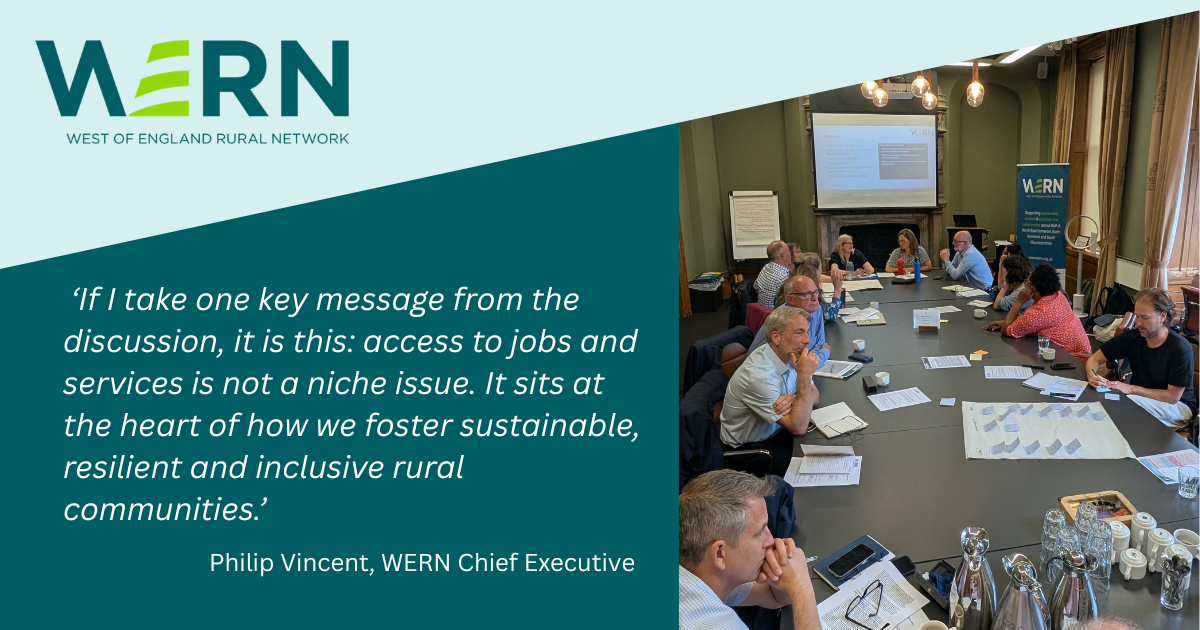
On Tuesday 2 June, I was delighted to welcome Helen Godwin, Mayor of the West of England, alongside senior representatives from local authorities, the NHS, charitable foundations and infrastructure organisations to our inaugural session which focused on access to jobs and services.
We began by sharing data highlighting the scale of the challenge. But what resonated most were examples of lived experiences shared by Simone Shepard, our Community Engagement Manager. These included the story of a young mother feeling isolated and struggling with her mental health while her partner takes the car to work, leaving her with no nearby facilities—and of a young man walking two miles along busy country roads to collect food bank parcels, putting his safety at risk.
Attendees were keen to share their own reflections. There was broad recognition that while transport provision and digital infrastructure need improvement, lower population densities make delivery more costly. A fundamental tension also emerged between providing universal services and targeting support towards those most in need.
Beyond the impasse – the power of community
As the roundtable progressed, we split into break-out groups focused on transport and digital inclusion. These discussions began to shift the conversation away from intractable structural challenges towards more creative, locally driven solutions.
A key theme was that access is not just about helping people travel from A to B – it is also about strengthening community capacity and increasing opportunities closer to where people live.
One example discussed was how we might ‘move the door of the NHS closer to communities’. While primary care has historically been centralised in urban areas, current reforms present opportunities to expand outreach services in rural communities. This could enable people to better manage their health and reduce the need to travel for appointments. At the same time, there is also potential to build on the region’s network of 35+ community transport providers, which largely rely on volunteers to deliver flexible, locally tailored journeys—often for essential healthcare access.
Participants also identified opportunities to improve digital inclusion. Small-scale initiatives such as digital cafés in South Gloucestershire, WERN’s Tech Ready service in North Somerset, and device recycling schemes in Bath & North East Somerset could be replicated more widely. Organisations like Tech4Good are already helping to share this learning, but as ever, the challenge is securing funding to scale these approaches – particularly with greater involvement from businesses as well as the public sector.
What happens next matters
What was striking, particularly towards the close of the roundtable, was the strong appetite to continue working together to improve access in rural communities. This commitment reflects how the issue cuts across multiple policy areas, from transport and planning to health and economic development.
If I take one key message from the discussion, it is this: access to jobs and services is not a niche issue. It is an essential part of fostering more sustainable, resilient and inclusive rural communities.
There is now a real opportunity to build on the energy in the room – connecting existing work, amplifying what is already effective, and ensuring rural needs are properly reflected in regional strategies and investment decisions.
Over the coming months, we will convene further roundtables, including sessions focused on housing and on health and wellbeing. My hope is that the conversation continues to grow, that practical ideas emerge – and crucially – that we see tangible action as a result.
If you are interested in working with us on this agenda, I would be delighted to hear from you!